Preface:
One of the assignments in the CGST205 course is to meet with a community partner, someone who can offer unique perspectives from a rich life experience, one that we may not be accustomed to.
My community partner was Ana Ughetti. By the age of 22, she had moved 22 times. All around Colombia, Panama, and finally the US, where she has since had a life as a freelance artist, a wife, and as a mother.
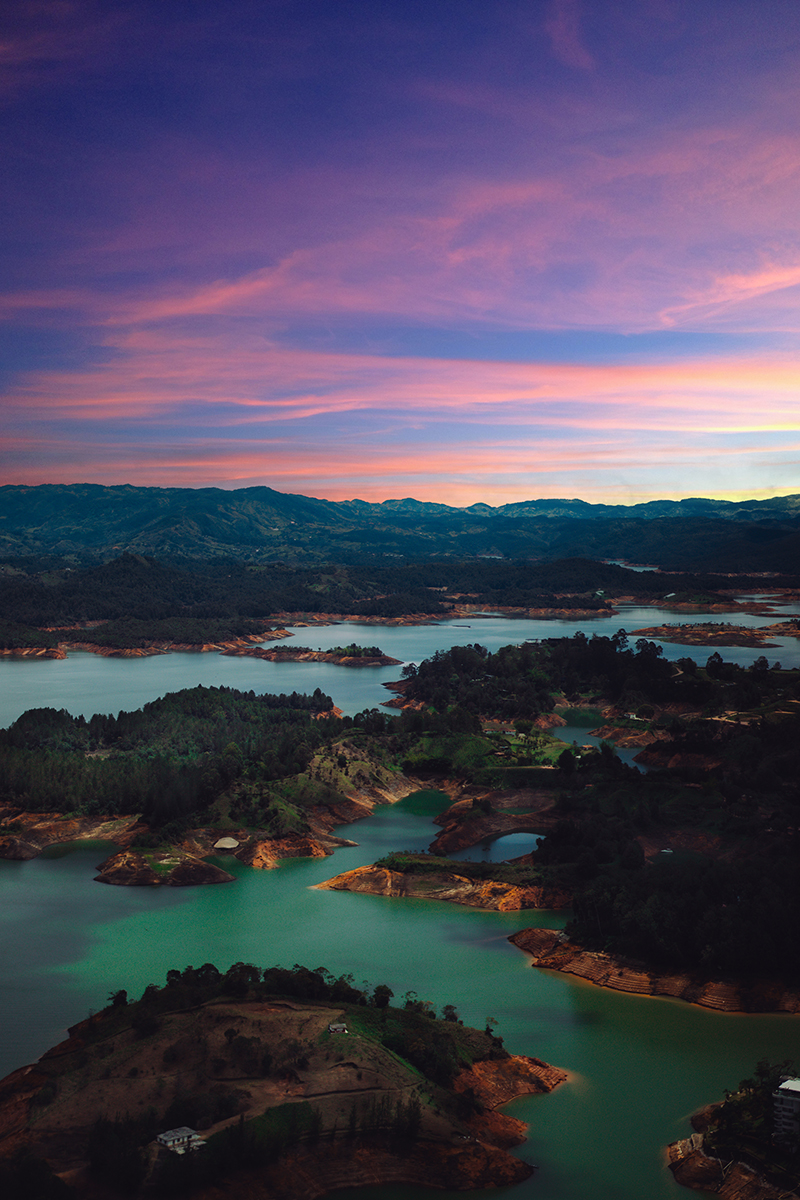
Her life is one of resilience, and my god it is admirable. Below is a reflection from one of our meetings, during which we spoke about recent Colombian history. It was such an unfathomably thought provoking conversation for me, as I actually visited Colombia with my brother in June of 2024, and we had a grand time—the photo here is from our trip. We visited Medellín, Guatape, and Santa Marta. Although, regrettably, I think we travelled without understanding the broader political and cultural happenings and climate of the country, we just wanted to have an amazing trip in a beautiful country. Now, Ana has illuminated that whole side of Colombia for me. Anyway, here is the reflection from our meeting:
One of the assignments in the CGST205 course is to meet with a community partner, someone who can offer unique perspectives from a rich life experience, one that we may not be accustomed to.
My community partner was Ana Ughetti. By the age of 22, she had moved 22 times. All around Colombia, Panama, and finally the US, where she has since had a life as a freelance artist, a wife, and as a mother.
Her life is one of resilience, and my god it is admirable. Below is a reflection from one of our meetings, during which we spoke about recent Colombian history. It was such an unfathomably thought provoking conversation for me, as I actually visited Colombia with my brother in June of 2024, and we had a grand time—the photos here are from our trip. We visited Medellín, Guatape, and Santa Marta. Although, regrettably, I think we travelled without understanding the broader political and cultural happenings and climate of the country, we just wanted to have an amazing trip in a beautiful country. Now, Ana has illuminated that whole side of Colombia for me. Anyway, here is the reflection from our meeting:
We began our meeting by talking about To End a War, a film that tries to make sense of Colombia’s long civil conflict, the guerillas, and the 2016 peace accord. What stayed with me, though, was not the documentary but Ana. Her voice shifted the conversation from history to lived experience, and suddenly the war felt much closer. She spoke about the government’s reintegration plan, which on the surface carried a kind of nobility. Most of the guerilla fighters had not joined by choice. Many had been taken as children or threatened into the group and told to join or die, or join or watch their family disappear. The peace accord imagined a way to return these men to society. It tried to give them a path back into the world beyond the jungle, and in theory it sounded compassionate. In reality, she thinks it was careless.
Sixteen former fighters were placed three blocks from the apartment where Ana lived with her mother and sister. They were paid subsidies to settle in and start over, yet the community around them was never prepared for what that sudden shift would mean. Ana described it simply. Walking home from school across the park, she began to feel watched. A small, constant pressure. A change in the air. Over time it grew worse, and some of the men started stealing bikes and harassing people in the neighborhood. Then came the bomb. The explosion tore through the street and shattered the windows of Ana’s apartment despite being three blocks away. Her mother was not home. She still had to go to school the next morning. That detail stayed with me more than anything else. The idea that a community could be shaken so violently and still be expected to continue as though nothing had been disrupted. Ana’s disappointment in the Colombian government is grounded in experiences like this. She was not speaking in policy terms or political slogans, she was speaking about the fear in her neighborhood, the broken glass, the sudden awareness that a peace agreement on paper can still fracture the lives of the people who have to live beside it. She spoke about the human cost of the conflict, the thousands of lives transformed or destroyed over decades, and the sense that those costs were treated as footnotes rather than central considerations.
Listening to her was eye-opening in a way no documentary could ever be. She was not recounting statistics or abstractions, she was reliving something real, and something obviously painful. Her voice wavered at moments, out of resilience, not weakness. The conversation left me with a deeper understanding of Ana, and just how admirable of a person she truly is.
I am so grateful for GEM for giving me the opportunity to meet Ana and learn from her experiences.
